
Blog 13: New York Just Banned AI for Kids. Did They Get It Right?
The biggest school system in the US just told nearly 600,000 students they can't use AI at school. New York City's mayor announced a one year ban covering pre-K through eighth grade. High schoolers can still use it, but only in limited pilot programs with AI literacy classes, and companion chatbots, the ones built to give emotional support, are banned for every grade (AFP). I'm in grade 10, so I'm on the "allowed, sort of" side of this. I still have opinions. New York isn't the only one. Hours after that announcement, Los Angeles paused AI on school devices for the whole school year, and in Chicago some school board candidates are pushing for a three year pause (Guliyev). Teachers aren't exactly calm either. An NPR/Ipsos poll found that 55 percent of teachers think students mostly use AI as a shortcut to avoid work, and 57 percent say it makes it harder to tell what students actually know (Guliyev). I'd be lying if I said that doesn't match what I see in class. Here's what I agree with. Banning companion chatbots is smart. I wrote earlier about how chatbot friends can leave teenagers lonelier, and I would not want a twelve year old learning to open an app first every time something feels bad. Here's what I don't agree with. A blanket ban treats AI like a light switch, when the real problem is how it's built and how it's used. In the Wharton and Penn study from blog 11, students who practiced with regular GPT-4 did 17 percent worse on an exam without it. But the students who got a version designed to give hints instead of answers mostly avoided that damage (Bastani et al.). Same technology, very different result. To me that says the fix is better design and better habits, not zero access. A ban is also hard to enforce. Google's Gemini can pop up when students search on school Chromebooks (Guliyev), so AI is already inside the tools schools use. And a school rule does nothing about what happens at home. Kids will still use it there, just with nobody teaching them how to use it properly, and the ones who get hurt most are the ones with the least support outside of school. Janice Jackson, a former CEO of Chicago Public Schools, also warned that broad bans could take away tools that really help students with special needs and students learning English (Guliyev). To be fair, the other side has a real point. Mayor Mamdani said kids need teachers, human connection, and the chance to struggle through hard problems on their own (AFP), and I agree with that. A one year pause with a task force studying the results isn't a crazy idea, especially since even Jackson says it's too early to judge any of these policies (Guliyev). But the pause only works if the year actually gets used to build AI that makes students think first, and to teach kids how to use it. If it's just a waiting room, then next year a 14 year old gets handed the full unrestricted tool with zero practice, which is exactly the situation the ban was supposed to prevent. So my take is simple. Ban the shortcut, not the tool. Works Cited AFP. "US's Largest School System Bans AI Use for Students until High School." VnExpress International, 5 Sept. 2026, e.vnexpress.net/news/tech/tech-news/us-s-largest-school-system-bans-ai-use-for-students-until-high-school-5116162.html. Bastani, Hamsa, et al. "Generative AI without Guardrails Can Harm Learning: Evidence from High School Mathematics." Proceedings of the National Academy of Sciences, vol. 122, 2025, article e2422633122. Guliyev, Aghakazim. "AI Backlash Reaches the Classroom in US." Caliber.az, 8 Sept. 2026, caliber.az/en/post/ai-backlash-reaches-the-classroom-in-us.
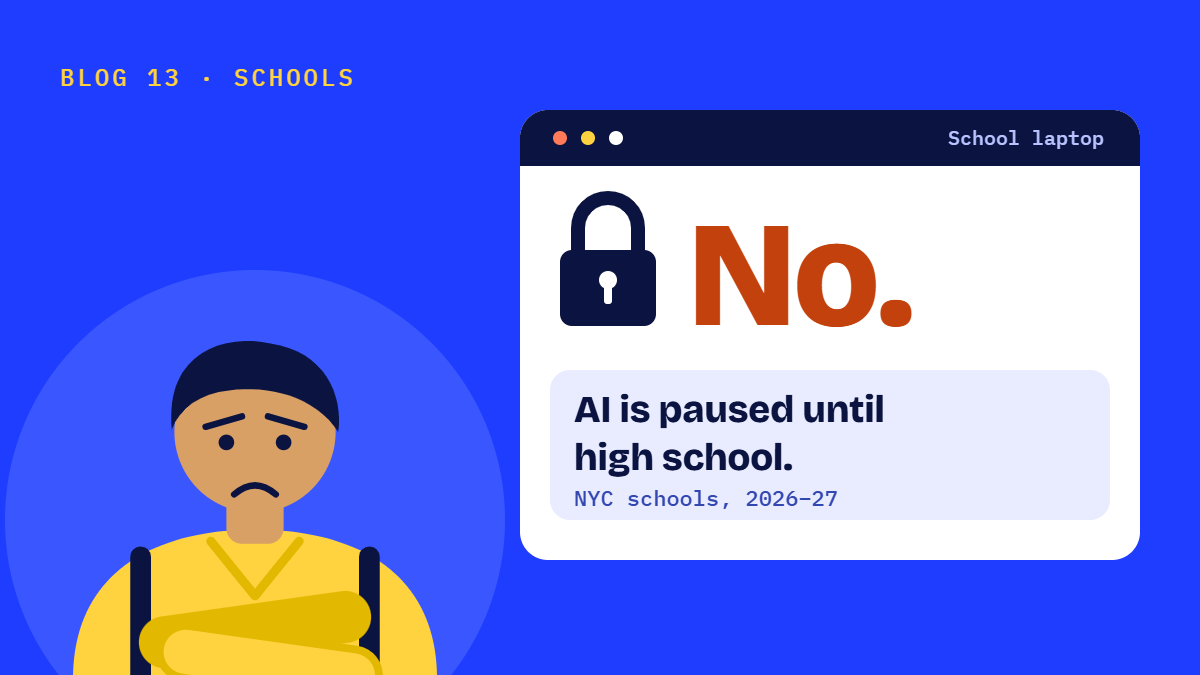
The biggest school system in the US just told nearly 600,000 students they can't use AI at school. New York City's mayor announced a one year ban covering pre-K through eighth grade. High schoolers can still use it, but only in limited pilot programs with AI literacy classes, and companion chatbots, the ones built to give emotional support, are banned for every grade (AFP). I'm in grade 10, so I'm on the "allowed, sort of" side of this. I still have opinions.
New York isn't the only one. Hours after that announcement, Los Angeles paused AI on school devices for the whole school year, and in Chicago some school board candidates are pushing for a three year pause (Guliyev). Teachers aren't exactly calm either. An NPR/Ipsos poll found that 55 percent of teachers think students mostly use AI as a shortcut to avoid work, and 57 percent say it makes it harder to tell what students actually know (Guliyev). I'd be lying if I said that doesn't match what I see in class.
Here's what I agree with. Banning companion chatbots is smart. I wrote earlier about how chatbot friends can leave teenagers lonelier, and I would not want a twelve year old learning to open an app first every time something feels bad.
Here's what I don't agree with. A blanket ban treats AI like a light switch, when the real problem is how it's built and how it's used. In the Wharton and Penn study from blog 11, students who practiced with regular GPT-4 did 17 percent worse on an exam without it. But the students who got a version designed to give hints instead of answers mostly avoided that damage (Bastani et al.). Same technology, very different result. To me that says the fix is better design and better habits, not zero access.
A ban is also hard to enforce. Google's Gemini can pop up when students search on school Chromebooks (Guliyev), so AI is already inside the tools schools use. And a school rule does nothing about what happens at home. Kids will still use it there, just with nobody teaching them how to use it properly, and the ones who get hurt most are the ones with the least support outside of school. Janice Jackson, a former CEO of Chicago Public Schools, also warned that broad bans could take away tools that really help students with special needs and students learning English (Guliyev).
To be fair, the other side has a real point. Mayor Mamdani said kids need teachers, human connection, and the chance to struggle through hard problems on their own (AFP), and I agree with that. A one year pause with a task force studying the results isn't a crazy idea, especially since even Jackson says it's too early to judge any of these policies (Guliyev). But the pause only works if the year actually gets used to build AI that makes students think first, and to teach kids how to use it. If it's just a waiting room, then next year a 14 year old gets handed the full unrestricted tool with zero practice, which is exactly the situation the ban was supposed to prevent.
So my take is simple. Ban the shortcut, not the tool.
Works Cited AFP. "US's Largest School System Bans AI Use for Students until High School." VnExpress International, 5 Sept. 2026, e.vnexpress.net/news/tech/tech-news/us-s-largest-school-system-bans-ai-use-for-students-until-high-school-5116162.html. Bastani, Hamsa, et al. "Generative AI without Guardrails Can Harm Learning: Evidence from High School Mathematics." Proceedings of the National Academy of Sciences, vol. 122, 2025, article e2422633122. Guliyev, Aghakazim. "AI Backlash Reaches the Classroom in US." Caliber.az, 8 Sept. 2026, caliber.az/en/post/ai-backlash-reaches-the-classroom-in-us.
Share this post
Comments (0)
No comments yet. Be the first to comment!